04/05/26
Supporting farmer resilience through SMS
Across origins, ECOM’s Sustainable Management Services (SMS) teams work to strengthen productivity, improve livelihoods, and support more resilient farming communities by combining technical expertise with locally adapted solutions. In Colombia and Kenya, this approach brings together agronomic practices, market access, and social considerations to address interconnected challenges and support long-term sustainability.
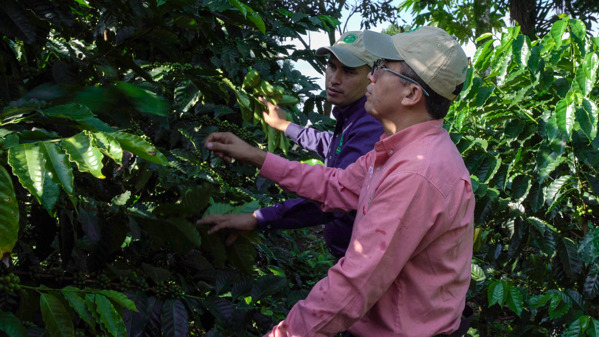
SMS Colombia: The SADER Project
Since 2023, our SMS team in Colombia has been implementing the SADER Project (Seguridad Alimentaria y Desarollo Rural), working with 600 smallholder coffee farming families in Cauca and Huila. In partnership with Caritas Norge and funded by Norad, the initiative is centered around two main objectives: improving food security and rural development by increasing producers’ income and market access, while strengthening the resilience of communities affected by climate change.
Since its launch, the project has made steady progress. Under the first objective, farms have joined certified specialty coffee programs like C.A.F.E Practices and Rainforest Alliance. Efforts have also focused on boosting productivity and profitability through soil analysis, fertilisation plans, export training for the European market, and the delivery of educational materials on deforestation. Additional tools– including farm management plans, cost-of-production kits, and annual feasibility assessments– also help farmers to make more informed decisions.
For the project’s second objective, agroforestry systems have been introduced through tailored farm plans, tree distribution, and maintenance incentives. Farmers are also now participating in environmental service payment platforms, and carbon footprint data is being collected to support longer-term sustainability strategies.
A regenerative agriculture strategy has been developed by our regional working group, alongside soil and biodiversity restoration practices and farm-specific solutions. Finally, climate-smart agriculture training has been rolled out, covering climate change, resilience, and sustainability, to further support farmers in understanding climate risks and strengthening the resilience of their production systems.
We are looking forward to building on this progress in the years to come, working towards the project’s objectives and contributing to the development and expansion of a resilient coffee sector.
SMS Kenya: Pioneering of GALS
In 2014, SMS Kenya strengthened its approach to supporting smallholder coffee farmers. While technical training and advisory services were already in place, persistent challenges– including low productivity, gender inequalities, and limited household incomes– highlighted the need for a more integrated approach.
That same year, SMS partnered with Hivos and other organisations to explore the Gender Action Learning System (GALS), a participatory methodology developed by Dr. Linda Mayoux, a renowned consultant and advocate for women’s empowerment. Following an initial training in Tanzania, SMS and its partners introduced GALS to coffee-producing communities in Kenya through the 4S@Scale project.
Initial sessions brought together farmer promoters from cooperative societies across Embu County. While the approach– based on participatory tools such as vision mapping and household dialogue– was new to many, it enabled farmers to better define their goals and reflect on decision-making at both farm and household level. Over time, this contributed to improved collaboration within households and a clearer link between farm management and income generation.
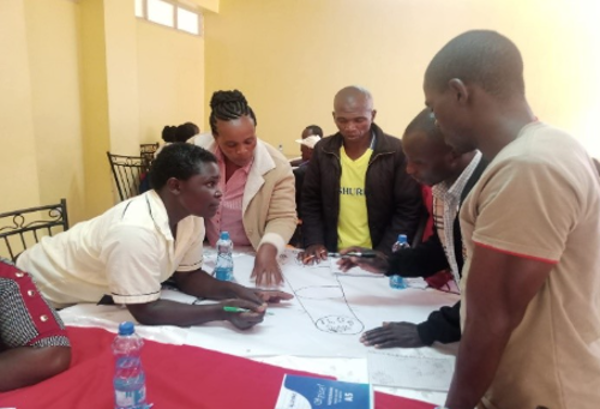
Following initial progress, the approach was expanded to additional regions, including Bungoma County. Continued engagement indicated improvements in both farm practices and household planning.
A key development came as SMS and its partners began integrating GALS with Good Agricultural Practices (GAPs), helping align technical training with farmers’ realities. This supported stronger adoption of practices such as pruning and soil management, contributing to a more holistic approach linking social inclusion, productivity, and environmental stewardship.
Building on these learnings, SMS has contributed to several national programmes supported by IFAD and other partners, including UTaNRMP, SDCP, ABDP, and KCEP-CRAL, and continues its involvement through KeLCoP in collaboration with AESA East Africa.
More recently, under the Coffee Farmer Income Resilience Programme (CFIRP) with IDH, The Sustainable Trade Initiative, farmers have further strengthened their adoption of regenerative agriculture practices, with a focus on soil health, farm resilience, and long-term income stability.
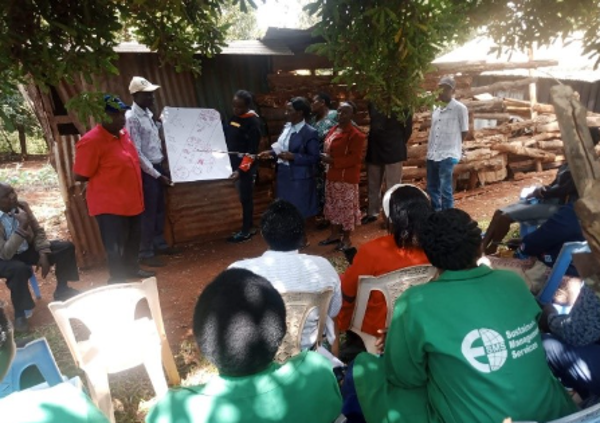
Today, GALS remains an important component of SMS’s work in Kenya, demonstrating how social inclusion, economic resilience, and environmental practices can reinforce each other to support more sustainable coffee production systems.
More news
News
Click to read this articleECOM Italia: 10 years of growth and a new chapter for Esperanto Coffee
ECOM Italia recently celebrated 10 years since opening its first office in Genoa in 2016! As part of this continued development, Esperanto, the specialty coffee brand created by ECOM Italia in 2022, is now Esperanto Coffee: a new company based in Trieste, created to support this growth and offer coffee professionals an even more complete range of products and services.
News
Click to read this articleCóndor hosts Maestros Productores specialty coffee competition
Last month, Maestros Productores 2026 microlot competition brought together some of Colombia’s finest specialty coffee offerings.
News
Click to read this articleCAMSA celebrates 26 years!
CAMSA, our subsidiary in Peru, recently celebrated 26 years since opening its first office in 2000– a history shaped by its ability to adapt, grow and evolve alongside the country’s coffee and cocoa supply chains.
News
Click to read this article2025 Group Sustainability Report (GSR)
We are pleased to share the release of our 2025 Group Sustainability Report, highlighting the progress made across our coffee, cocoa, cotton, and nuts and ingredients supply chains over the past year.
News
Click to read this articleSupporting coffee farming families in Santander alongside Colcafé and Nutresa
After four years of collaboration, ECOM and its partners have concluded our "Café, Biodiversidad y Desarrollo de Empresas Familiares" programme, an initiative focused on strengthening family coffee businesses through partnership, commitment and a shared long-term vision.
News
Click to read this article'ECO': ECOM Mexico’s new virtual people partner
With only around 450 of ECOM Mexico's 1,300 employees holding a corporate email account, Human Resources created ECO– an AI-powered Virtual People Partner available on WhatsApp– to strengthen the connection with employees, enhance their experience, and open new channels to hear their voices.
News
Click to read this articleECOM SMS Verified achieves recognition as a sustainable coffee scheme
The Global Coffee Platform (GCP) recently recognised ECOM’s SMS Verified for the third time as equivalent to their Sustainable Reference Code, with this recognition valid through July 2028. This recognition follows an extensive documentation review process covering sustainability-related requirements and alignment with the GCP’s guidelines.
News
Click to read this articleAcquistion of Universal Commodities (Tea) Trading, Inc. to the ECOM Group
We are pleased to announce that Universal Commodities (Tea) Trading (UCTT), will be joining the ECOM Group, marking an important step in expanding its global soft commodities platform and establishing its presence in the tea sector.
News
Click to read this articleSilent Brew, Strong Voices Project Updates
Following the SCTA Next Gen's Sustainability Award for our project 'Silent Brew, Strong Voices', we're proud to share an update on the impact this project is having in Pu'er, China.