15/01/25
Leading Sustainable Coffee Farming in Kitsutsu Village, Uganda
In the rural community of Kitsutsu village, Kasese District in Uganda, Mrs. Ithungu Zeresi Kighoma has become a beacon of progress in sustainable coffee farming. As a mother, coffee farmer, and tailor, she has leveraged training and support from Kawacom’s Ugandan Smallholder Livelihoods Initiative to enhance her farm’s productivity and secure a stable income for her family.
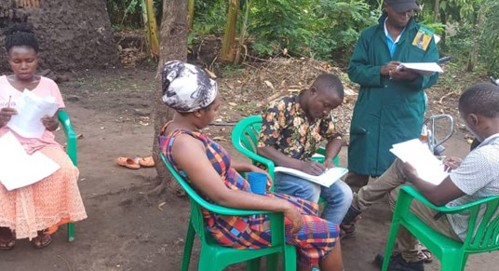
Before joining the initiative, Ithungu faced many obstacles common among smallholder farmers, including low yields. Through training provided by Kawacom, Ithungu learned essential techniques such as pruning, organic fertilization, and proper coffee drying and storage. These skills have not only enhanced her productivity but also qualified her farm for Organic and Rainforest Alliance certifications, unlocking access to premium markets.
"I had limited knowledge of coffee agronomic practices, inadequate post-harvest handling, and no reliable access to markets," Mrs. Kighoma.
Today, coffee accounts for 75% of Ithungu’s income. The earnings from her coffee sales allow her to pay school fees for her children, improve her home, and reinvest in her farm. Ithungu’s farm has become a model for sustainable practices in Kitsutsu, inspiring other women to embrace improved farming methods. Her success underscores the critical role women play in Uganda’s agricultural sector when given the tools and opportunities to thrive.
"We use the income from coffee sales to meet household needs and invest in better farming practices," Mrs. Kighoma.
In Kitsutsu village, Kawacom is supporting the community as part of the Ugandan Smallholder Livelihoods Initiative, a USAID partnership that focuses on empowering smallholder farmers through training, certification, and market linkages, with a strong emphasis on women and youth inclusion. Kawacom has trained 45 farmers in Kitsutsu (40 of them women) on: Good Agronomic practices, Post-Harvest Handling, Organic and Rainforest Alliance standards, Financial Literacy, and Income Diversification. These efforts have led to significant improvements in coffee quality, increased yields, and higher incomes for farmers.
"Pruning and fertilization techniques, especially using organic inputs, have improved my coffee quality and yields," Mrs. Kigoma.
Looking ahead, Ithungu remains focused on further improving her farm and contributing to her community. Kawacom’s continued support, including clean planting material and centralized processing facilities, aligns with these aspirations, ensuring farmers like Ithungu have the resources they need to succeed.
More news
Insights
Click to read this articleBuilding a traceability system in our European factories
Robert Jan van Beekhoff, Operations & Supply Chain Advisor at ECOM Cocoa Theobroma, shares key insights into the technical and operational changes required to build an end-to-end traceability system capable of linking geo-location data directly to finished cocoa products.
Insights
Click to read this articleERDA by ECOM Research
ECOM Research developed a sector-specific approach in 2023, designed to accurately detect deforestation in cocoa and coffee landscapes. ECOM Research Deforestation Analysis (ERDA), is a tool built to improve accuracy and reliability in deforestation monitoring.
News
Click to read this articleBrewing resilience: researchers safeguard coffee and chocolate from climate threats
Climate change poses growing risks to coffee and cocoa production worldwide. Featuring ECOM’s work alongside researchers and industry partners, this article from the EU’s Horizon Magazine highlights collective efforts to protect these crops and strengthen farmer resilience.
Research
Click to read this articleCMPs significantly decreased deforestation in the most at-risk protected areas in Africa since 2000
This article explores collaborative management partnerships (CMPs) between state wildlife authorities and nonprofit conservation organizations to manage protected areas (PAs) have been used increasingly across Sub-Saharan Africa since the 2000s.
Insights
Click to read this articleThe Cocoa Price - A Key Factor for a Living Income for Farmers
SWISSCO has published a brief regarding perspectives and solutions regarding the price of cocoa and how it is relevant for a living income for farmers.
Insights
Click to read this articleECOM's Green Meter
We are pleased to announce the official rollout of our internal carbon calculator, Green Meter, which has been third-party reviewed by SustainCERT.
Research
Click to read this articleClimate-Smart Agriculture and Agroforestry in Cocoa
This guidance document was published by SWISSCO and focuses on approaches, financing needs and opportunities as well as providing high level guidance for stakeholders in the cocoa sector seeking to establish a broad range of actions that take the complexity of crop- and site-specific impacts of climate change and the realities of smallholder cocoa farmers into account.
Insights
Click to read this articleBeginners guide to Carbon Credits
This report provides an overview of the Voluntary Carbon Market (VCM), from what it is to the roles of carbon standards, governments, and Indigenous Peoples in the VCM.
Research
Click to read this articleGoogle Earth Engine, an innovative technology for forest conservation
This report explores how Google Earth Engine (GEE) can and has been used as a land monitoring tool to help enforce forest protection laws, co-authored by ECOM's SMS Manager Coffee, Thuan Sarzynski.