01/08/24
ACOM & SMS combat climate change in Vietnam
Article by: Michaela Tomchek
Research has revealed that climate change will significantly impact agricultural production, especially the delicate regions where coffee grows. Increased temperatures and altered precipitation patterns will lead to decreased yields and quality. In Vietnam, slight shifts in climate have already begun to impact production.
Temperatures are predicted to continue increasing within the country, leading to a rise in evapotranspiration: the evaporation from moisture in soil and groundwater resources. Consequently, crops such as coffee will require more irrigation or external water inputs. In addition to higher temperatures, there will also be an increase in rain fall, which can adversely impact the flowering season of coffee. This warmer and moister environment make it easier for diseases to spread and thrive. With these shifts in climate, coffee yields are predicted to decrease. With heavier, more frequent rain fall, it will be more difficult to dry the coffee properly and evenly, meaning overall quality will be impacted during post-harvest.
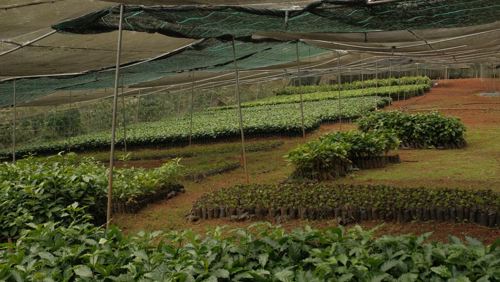
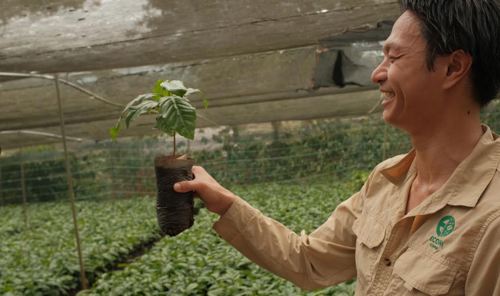
With these projections, adaptation and mitigation measures must be enforced in order to maintain production. ACOM and SMS have begun implementing various initiatives to assist farmers with preparing for these changes. According to Thuận Sarzynski, SMS Manager in Vietnam, there are various plans being put into place, including agroforestry training, crop insurance, and a loan program for irrigation.
SMS are also training farmers to plant fruit trees to, firstly, provide coffee plants with a cooler environment under the shade of fruit trees, and secondly, to give farmers an additional source of income. This is known as agroforestry, an adaptation and mitigation method to climate change, which typically combines food crops, such as coffee, with perennial tree crops, such as banana or other native trees. Soil health also benefits from agroforestry with a more biodiverse ecosystem and root structures to prevent soil erosion or nutrient depletion.
Additionally, SMS is assisting farmers by connecting them to insurance companies to help insure their crops for when there is a climate disaster. Loans are also provided to producers by SMS with the support of the International Finance Corporation (IFC) to acquire Netafim irrigation systems. These systems will help provide water in times of drought or in dryer areas where soils need more moisture. With this support, producers are able to be more prepared in times when there is less rainfall.
Considerable research focused on varietal trials is being conducted to understand which coffee plants fare best in different conditions under the Breedcafs program. Additionally, the BOLERO project is working on grafting to assess different root stocks and how they react to different climate conditions. Other SMS initiatives are focusing on insurance and researching CBB impacts.
SMS is also offering training to farmers with a focus on climate change to educate them about the impacts and the methods of adaptation. They specifically focus on Good Agricultural Practices (GAP) and project activities. These training sessions are offered 1-2 times a year for producers to learn more from the SMS agronomists.
Looking towards the future, SMS are constantly regulating and modelling climate changes, with a research team looking at weather patterns to predict future yields in the long term and short term (2-3 months). These data and predicted temperatures allow SMS to be better equipped to prepare producers with adaptation methods.
With projections revealing an imminent increase in temperatures and alterations in precipitation patterns, the initiatives and projects put in place by SMS are vital for the health and stability of coffee in Vietnam.
More news
Insights
Click to read this articleBuilding a traceability system in our European factories
Robert Jan van Beekhoff, Operations & Supply Chain Advisor at ECOM Cocoa Theobroma, shares key insights into the technical and operational changes required to build an end-to-end traceability system capable of linking geo-location data directly to finished cocoa products.
Insights
Click to read this articleERDA by ECOM Research
ECOM Research developed a sector-specific approach in 2023, designed to accurately detect deforestation in cocoa and coffee landscapes. ECOM Research Deforestation Analysis (ERDA), is a tool built to improve accuracy and reliability in deforestation monitoring.
News
Click to read this articleBrewing resilience: researchers safeguard coffee and chocolate from climate threats
Climate change poses growing risks to coffee and cocoa production worldwide. Featuring ECOM’s work alongside researchers and industry partners, this article from the EU’s Horizon Magazine highlights collective efforts to protect these crops and strengthen farmer resilience.
Research
Click to read this articleCMPs significantly decreased deforestation in the most at-risk protected areas in Africa since 2000
This article explores collaborative management partnerships (CMPs) between state wildlife authorities and nonprofit conservation organizations to manage protected areas (PAs) have been used increasingly across Sub-Saharan Africa since the 2000s.
Insights
Click to read this articleThe Cocoa Price - A Key Factor for a Living Income for Farmers
SWISSCO has published a brief regarding perspectives and solutions regarding the price of cocoa and how it is relevant for a living income for farmers.
Insights
Click to read this articleECOM's Green Meter
We are pleased to announce the official rollout of our internal carbon calculator, Green Meter, which has been third-party reviewed by SustainCERT.
Research
Click to read this articleClimate-Smart Agriculture and Agroforestry in Cocoa
This guidance document was published by SWISSCO and focuses on approaches, financing needs and opportunities as well as providing high level guidance for stakeholders in the cocoa sector seeking to establish a broad range of actions that take the complexity of crop- and site-specific impacts of climate change and the realities of smallholder cocoa farmers into account.
Insights
Click to read this articleBeginners guide to Carbon Credits
This report provides an overview of the Voluntary Carbon Market (VCM), from what it is to the roles of carbon standards, governments, and Indigenous Peoples in the VCM.
Research
Click to read this articleGoogle Earth Engine, an innovative technology for forest conservation
This report explores how Google Earth Engine (GEE) can and has been used as a land monitoring tool to help enforce forest protection laws, co-authored by ECOM's SMS Manager Coffee, Thuan Sarzynski.