The potential impact of climate change upon our cocoa supply chain
30/08/23
Article written by Ryo Kurashina, Data Scientist, ECOM Research
Growing ‘suitability’ of existing cocoa acreage is projected to decrease under climate change
The ECOM Research department conducted a study into the potential impact of climate change upon our cocoa supply chain. Modelling across 12 cocoa origins has shown the growing suitability of existing cocoa acreage is projected to decrease under realistic IPCC climate change scenarios.
Why is this important?
A cocoa farm's suitability provides insight into the available land area for cultivation. Anticipated changes in a farm’s suitability underscores the need to measure and assess it, facilitating the development of effective intervention strategies. This approach enables us to proactively help to mitigate potential adverse effects on our supply chain.
What’s driving the decrease in cocoa suitability?
The release of CO2 into the atmosphere through the burning of fossil fuels is set to bring a marked shift to our planet’s environment in the coming decades. Under a realistic ‘medium’ emissions scenario, average surface temperatures at origin are set to rise at a rate of 1°C every 30 years. Rainfall on average is also set to decrease but these values were found to vary more widely.
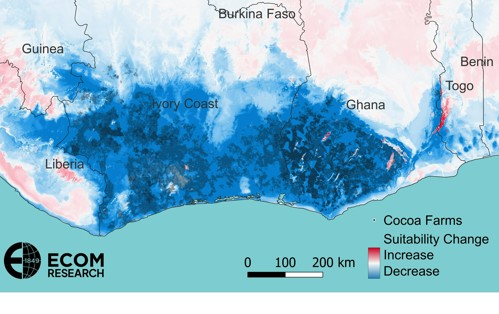
We found that this combination of increasing temperatures, particularly in the warmest quarter of the year, and decreasing annual rainfall creates an environment under which cocoa is not expected to grow as productively as it does under current climatic conditions. This signal is much clearer in West Africa than it is in South America, which likely explains the larger projected decrease in cocoa suitability.
How did we come to this conclusion?
Harnessing high-resolution climate data, the known locations of cocoa farms and machine learning techniques, we were able to build a picture of the cocoa growing ecologies in West Africa and South America. This was done by training a machine learning model to ‘learn’ the favourable climatic conditions in which cocoa grows. For example, how much annual rainfall does cocoa need? What temperatures does it prefer to grow in? This is all information that may be extracted by the model during the training process.
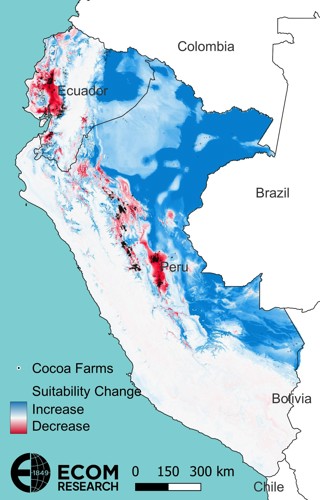
Currently, 85-90% (1) of farms are classified by the model as ‘suitable’ to grow cocoa in West Africa and South America. We found that the suitability of most of these farms is projected to decrease under climate change (see Figs. 1 and 2). In both Côte D’Ivoire and Ghana, a consistent reduction in suitability is observed owing to the uniformity of climate within the cocoa-growing regions (Fig. 1).
In Peru and Ecuador, the picture is a little different due to the variations in climate attributed to the presence of the Andes. Despite large areas of suitability increase projected, most of the farms in our supply chain are still expected to decrease in suitability (see Fig. 2).
Is it all bad news?
Not necessarily. Our analysis assumes a zero intervention strategy. Hence, under the correct actions, such as increased canopy shade and irrigation, many of the negative consequences that are currently projected may be mitigated. In addition, there is ongoing research that suggests that some of the projected suitability decrease may be offset by the increase in CO2 concentrations in the atmosphere (2). However, it is important to note that research into this hypothesis is still in its early stages and more work is required to verify these ideas.
This article is a summary of the full report that ECOM Research produced with respect to cocoa suitability. Further detail is available upon request.
ECOM RESEARCH: Richard Puddifoot (Head of Research); Laurent Souron (Cocoa); Digby Beatson-Hird (Coffee); Roberto Ruiz (Cotton); Juan Beltran, Ryo Kurashina, Darrell Hoffman (Data Scientists)
(1) Given perfect knowledge of all cocoa farms, this value would be equal to, or very close to, 100%. However in practice this is never the case due to incomplete data. Hence, a model such as this will always misclassify some farms as unsuitable.
(2) Black, Emily, et al. "Cocoa plant productivity in West Africa under climate change: a modelling and experimental study." Environmental Research Letters 16.1 (2020): 014009.
Research Disclaimer
This research was originally prepared and issued by ARL Commodities Ltd (“ARL”) for distribution to their customers. References in this document to ARL include all of ARL’s affiliates and group companies. All material presented in this document, unless specifically indicated otherwise, is under copyright to ARL. None of the material, nor its content, nor any copy of it, may be altered in any way, transmitted to, copied or distributed to any other party, without the prior express written permission of ARL. All trademarks, service marks and logos used in this document are trademarks or service marks or registered trademarks or service marks of ARL or its affiliates. The information, tools and material presented in this document are provided to you for information purposes only and are not to be used or considered as a recommendation to sell or to buy commodities, commodity derivatives, or any other related products. Nothing in this document constitutes investment, legal, accounting or tax advice, or a representation that any investment or strategy is suitable or appropriate to your individual circumstances, or otherwise constitutes a personal recommendation to you. Information and opinions presented in this document have been obtained or derived from sources believed by ARL to be reliable, but ARL makes no representation as to their accuracy or completeness.
ARL accepts no liability for loss (whether direct, consequential or indirect) arising from the use of the material presented in this document. This document is not to be relied upon in substitution for the exercise of independent judgment. ARL may have issued, and may in the future issue, other communications that are inconsistent with, and reach different conclusions from, the information presented in this document. Those communications reflect the different assumptions, views and analytical methods of the analysts who prepared them and ARL is under no obligation to ensure that such other communications are brought to the attention of any recipient of this document. Information, opinions and estimates contained in this document reflect a judgement at its original date of publication by ARL and are subject to change without notice. ARL may participate or invest in commodities and commodity derivative transactions and/or have a position or holding, or other material interest, or effect transactions, in such commodities or commodity derivatives or other investments related thereto. In addition, it may make markets in the commodities and their derivatives mentioned in the material presented in this document. This document may provide the addresses of, or contain hyperlinks to, websites. Except to the extent to which the document refers to website material of ARL or its group companies, ARL has not reviewed any such site and takes no responsibility for the content contained therein. Such address or hyperlink (including addresses or hyperlinks to ARL’s own or its group's website material) is provided solely for your convenience and information and the content of any such website does not in any way form part of this document. Accessing such website or following such link through this document shall be at your own risk.
More news
News
Click to read this articleECOM Italia: 10 years of growth and a new chapter for Esperanto Coffee
ECOM Italia recently celebrated 10 years since opening its first office in Genoa in 2016! As part of this continued development, Esperanto, the specialty coffee brand created by ECOM Italia in 2022, is now Esperanto Coffee: a new company based in Trieste, created to support this growth and offer coffee professionals an even more complete range of products and services.
News
Click to read this articleCóndor hosts Maestros Productores specialty coffee competition
Last month, Maestros Productores 2026 microlot competition brought together some of Colombia’s finest specialty coffee offerings.
News
Click to read this articleCAMSA celebrates 26 years!
CAMSA, our subsidiary in Peru, recently celebrated 26 years since opening its first office in 2000– a history shaped by its ability to adapt, grow and evolve alongside the country’s coffee and cocoa supply chains.
News
Click to read this article2025 Group Sustainability Report (GSR)
We are pleased to share the release of our 2025 Group Sustainability Report, highlighting the progress made across our coffee, cocoa, cotton, and nuts and ingredients supply chains over the past year.
News
Click to read this articleSupporting coffee farming families in Santander alongside Colcafé and Nutresa
After four years of collaboration, ECOM and its partners have concluded our "Café, Biodiversidad y Desarrollo de Empresas Familiares" programme, an initiative focused on strengthening family coffee businesses through partnership, commitment and a shared long-term vision.
News
Click to read this article'ECO': ECOM Mexico’s new virtual people partner
With only around 450 of ECOM Mexico's 1,300 employees holding a corporate email account, Human Resources created ECO– an AI-powered Virtual People Partner available on WhatsApp– to strengthen the connection with employees, enhance their experience, and open new channels to hear their voices.
News
Click to read this articleECOM SMS Verified achieves recognition as a sustainable coffee scheme
The Global Coffee Platform (GCP) recently recognised ECOM’s SMS Verified for the third time as equivalent to their Sustainable Reference Code, with this recognition valid through July 2028. This recognition follows an extensive documentation review process covering sustainability-related requirements and alignment with the GCP’s guidelines.
News
Click to read this articleAcquistion of Universal Commodities (Tea) Trading, Inc. to the ECOM Group
We are pleased to announce that Universal Commodities (Tea) Trading (UCTT), will be joining the ECOM Group, marking an important step in expanding its global soft commodities platform and establishing its presence in the tea sector.
News
Click to read this articleSilent Brew, Strong Voices Project Updates
Following the SCTA Next Gen's Sustainability Award for our project 'Silent Brew, Strong Voices', we're proud to share an update on the impact this project is having in Pu'er, China.